
Dear Trust Owners: Let's All Take a Breath
By Thomas Warner
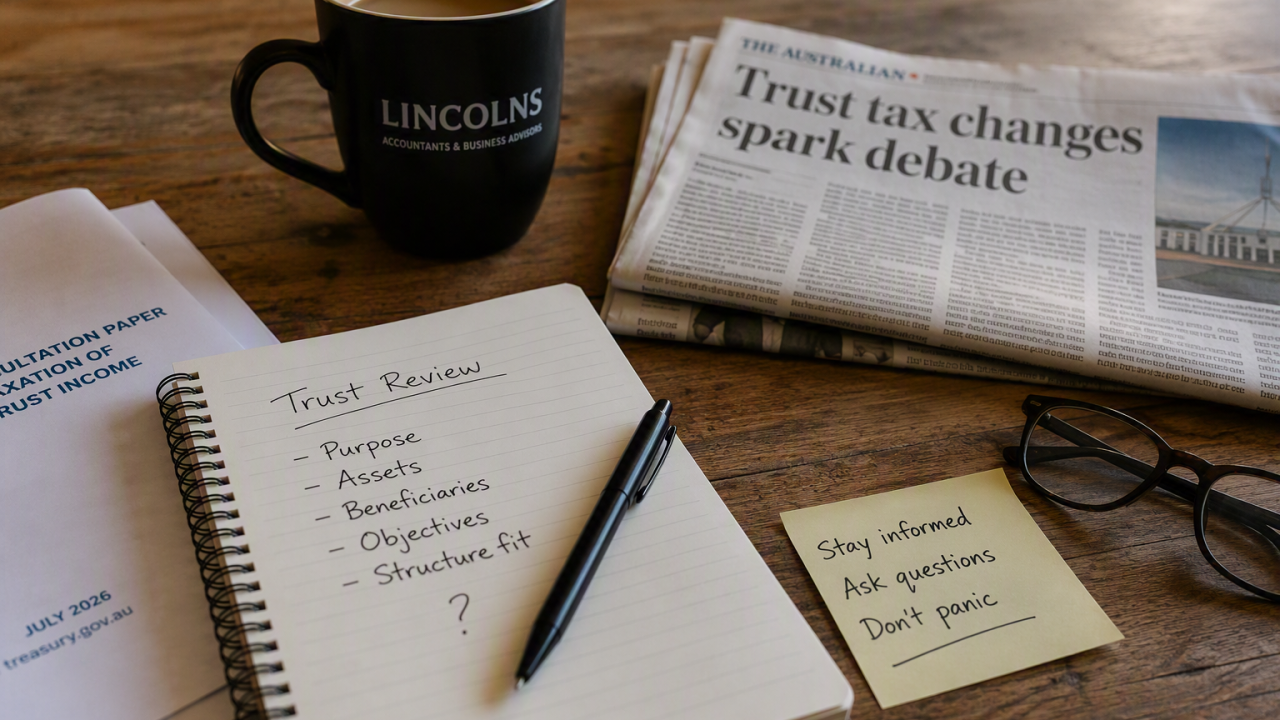
If you have a discretionary trust, chances are you have had at least one conversation about the proposed trust tax changes in the last few months.
Maybe it was at a barbecue. Maybe it was over a coffee. Maybe it was on Facebook, which is traditionally where complex tax policy goes for careful and balanced discussion. Just like the debate over whether Kirk or Shatner is the better Enterprise Captain.
You have probably heard some version of:
Trusts are dead
Everyone will have to restructure
The Government is coming after family businesses
My mate’s accountant reckons…
As accountants, those last four words generally trigger the same feeling a doctor gets when a patient says they have diagnosed themselves by doing a quick Google.
The reality is that we now have consultation papers and exposure draft legislation to work through. That is certainly more information than we had on Budget night, but it is not yet the final product and it definitely opens many more questions.
So, before anyone wheels the family trust deed to the kerb for bulk rubbish collection, let’s chat about what we know and what we don’t know.
Tax reform announcements tend to follow a fairly predictable cycle.
First comes the headline. Then comes social media. Then comes a bloke in a high-vis shirt who suddenly has stronger opinions on tax policy than Treasury. Eventually, someone reads the legislation.
Unfortunately, that last step is often optional.
The proposed 30% minimum tax on certain discretionary trusts has understandably generated concern. But after working through the consultation material, I do not think it tells us trusts are finished. I think it tells us trust taxation is changing.
What We Actually Know
The Government has proposed a 30% minimum tax on certain discretionary trusts from 1 July 2028. The proposed tax would be paid at trustee level, with a non-refundable tax credit available to eligible non-company beneficiaries for tax paid by the trustee on income that is distributed to them each year. This would mean that distributions to companies could be potentially taxed at rates nearing 55 – 60%.
So, to help out all of us, the government proposed a three-year roll-over relief from 1 July 2027 for those wishing to move assets from an affected discretionary trust into another structure, such as a company, fixed trust, partnership or sole trader’s name. So generous, except somebody forgot to tell the State Governments. If transfer duty still applies, there is a reasonable chance the biggest winners from the restructure concessions end up being the various Offices of State Revenue around Australia.
So as a late-night stroke of genius the government has proposed an “Excluded Election Trust” regime. Which has been shortened to "EET", because tax professionals apparently cannot function unless every second sentence contains an acronym. This would provide an elective option for exclusion from the minimum 30% tax treatment, but it comes with the typical disclaimers, (subject to the usual conditions, requirements, tests, elections and probably a requirement to wear odd socks on Tuesdays and eat mushrooms with custard.) Only problem is that in less than a day of announcing this some experts are already saying that exercising this election could attract transfer duty. Oops.
While the new election and the minimum tax rate for trusts are proposed laws, we did get some information that clarified the budget speech. Primary production income will be excluded from the minimum 30% tax and still taxed in the hands of the beneficiaries. How exactly primary production income will be calculated in some circumstances remains unclear. Which is unfortunate because farmers have a habit of wanting to know whether they are farmers.
What We Do Not Know
We do not yet know exactly what the final legislation will look like after consultation, amendments and parliamentary debate (deals that have to be made to get support).
Treasury has sought feedback on how the minimum tax should work, which trusts and income should be excluded, the definition of a fixed trust, the roll-over relief, the Excluded Election Trust regime and the treatment of excess franking credits. You know just a few of the key details that actually let us know make meaningful decisions.
Reading consultation material can feel a little like assembling flat-pack furniture. The overall picture is on the box, the instruction book is open, but there are still three screws left over and nobody is completely sure whether they are important. Plus, you have had to rebuild parts of it over five times.
But at least they are asking, the government are seeking feedback on the law changes via the consultation papers. But it does mean irreversible decisions should not be based on incomplete information. So, hold your horses. That high vis tax expert is missing a few important bits of information.
The Excluded Election Trust
One of the more interesting features is the proposed Excluded Election Trust. It sounds less like tax legislation and more like a support group.
‘Hi everyone, my name is Tom and I have an Excluded Election Trust.’
‘Hi Tom.’
Behind the name is an important point. The proposed regime appears to recognise that there may be more than one pathway for a trust under the new framework, bit like a pick your own destiny book. Except you can’t cheat and skip to the end and work out which choice is best.
A trust may be within the minimum tax rules,
May qualify for an exclusion such as having primary production income
May elect into the proposed alternative regime if eligible
May consider restructuring under the transitional roll-over
The final conditions will matter. The phrase ‘we will just make the election’ has historically created many happy hours for accountants and considerably fewer happy hours for everyone else.
Still, its inclusion supports a broader point: the policy design is not simply ‘trusts bad, end of discussion’.
Trusts Were Never Just About Tax
This is probably the most important point in the whole discussion.
One thing that gets lost in the debate is the assumption that trusts only exist because of tax. If that were true, most accountants would have stopped recommending them years ago. Trusts can be useful, but nobody has ever described them as refreshingly simple.
They come with resolutions, trust deeds, compliance obligations, administrative costs and, occasionally, the joy of interpreting a deed drafted in the 1980s by a lawyer who appears to have been determined to remove every possible trace of enjoyment from the English language.
Trusts are used for asset protection, succession planning, family wealth management, intergenerational ownership, business risk management and estate planning. For farming families and private business groups, they can also form part of a broader plan to hold assets and manage ownership across generations.
Those objectives do not disappear because tax rules change. The taxation outcome may change. The purpose will not.
The Better Question
Many people are asking, ‘Should I get rid of my trust?’
The better question is, "Why do I have it?" and hopefully the answer isn't "because somebody told Dad to do it in 1998 and we've all been too scared to touch it since."
If a trust was established mainly for tax flexibility, the proposed changes may cause the family to rethink its structure. If the trust forms part of a broader succession, asset protection or family wealth strategy, the answer may be different.
For some families, the trust may still be exactly where it should be. For others, restructuring may make sense once the final rules are known.
Do Not Let Fear Make the Decision
Major reform tends to produce two camps. One believes the sky is falling. The other believes nothing will change. History suggests both camps should pack an umbrella, but neither should start building an ark.
The biggest mistakes often happen at extremes. People panic and restructure too early, or they ignore the issue until the last possible moment. It's a bit like hearing there might be rain in six months and either selling the tractor or refusing to check the weather forecast again.
A better approach is to understand the developing rules, revisit why you have a trust and if it is still achieving its purpose of commercial, succession and asset protection objectives.
That was good advice before these proposals. It remains good advice now.
What Should You Do Now?
For most trust owners, the answer is not dramatic:
Stay informed.
Understand what the current structure holds and why it exists.
Keep the trust deed, succession plan and asset protection objectives in the same conversation as the tax outcome.
Do not panic, but do not ignore the issue either.
Wait for sufficient details before making irreversible changes.
Most importantly, be wary of advice that begins with, ‘Now, I am not an accountant, but...’ Nothing good in tax has ever followed that sentence.
After reading the consultation papers, I do not come away believing trusts are dead. I come away believing Treasury is trying to redefine how discretionary trusts fit within Australia’s tax system.
Trusts may still have a place. Trusts may still have a purpose. The challenge over the next couple of years will not be deciding whether trusts are universally good or bad. It will be understanding whether your trust still achieves what you need it to achieve under the final rules.
Until then, remain informed, remain curious and maintain a healthy degree of skepticism towards anyone who claims to have completely solved several hundred pages of draft legislation over a schooner and a parmi on a Friday night.
