
Building Wealth Beyond the Business
By Ben Cobussen
October 2026

For many business owners, years of hard work can create a successful, profitable business. But a profitable business and a wealthy business owner may not necessarily be the same thing. A significant portion of a business owner's wealth can remain tied up in business value, working capital, and operating assets. Those things have real value, but they may not provide the liquidity, diversified income, or flexibility that personal assets outside the business can provide.
If your business stopped tomorrow, what would still be generating income from you?
For business owners considering their next investment, purchasing their premises, or deciding what to do with surplus cash, this is a worthwhile question to ask.
Start with the why, not the what
Opportunities can often drive decisions.
The landlord decides to sell the premises. An investment property comes onto the market. The bank offers additional borrowing capacity.
Suddenly the conversation becomes, 'Should we buy it?'
The better first question is: "Why are we considering it?"
Is your priority financial security, creating an income stream outside the business, owning your premises, preparing for retirement, supporting succession plans, creating opportunities for your family, or simply having more choices in the future?
Different goals lead to different decisions. The investment itself is the tool. It is not the reason for the decision
The business-owner wealth trap
There are three patterns worth watching, and we see these time after time.
Concentration: If most of your wealth sits in one business or industry, your financial position can become heavily exposed to the same risks.
Dependency: If both your income and your wealth depend on the business continuing to operate, your options may become more limited when circumstances change.
Reaction: When opportunities are assessed one at a time rather than against an overall plan, each decision can look perfectly reasonable on its own while collectively moving you further away from your longer-term goals.
The aim isn't to stop investing in your business. For many owners, reinvesting in the business is exactly what has created their success.
The goal is to build choices beyond it!
Five decisions to make before you sign
Before committing to a significant investment, it can help to work through five questions, in order:
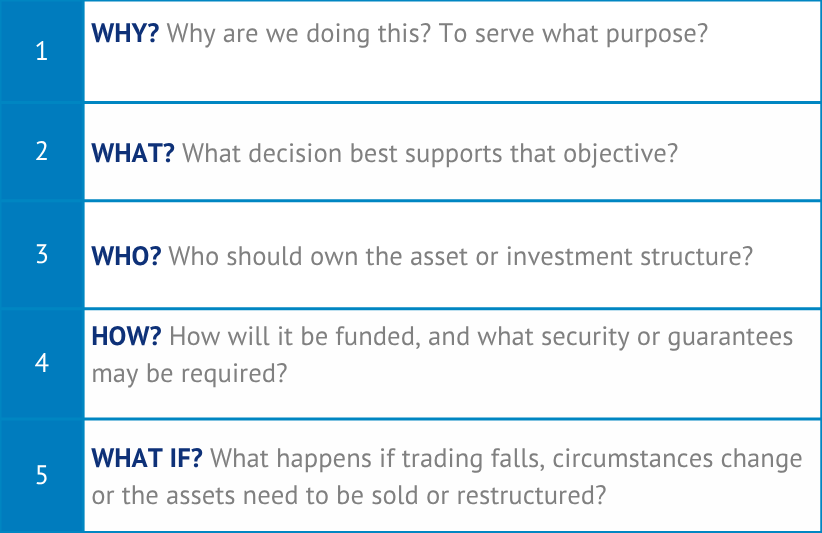
The order matters.
Starting with the “what” or the “who” can mean that important questions around structure, tax, risk, and longer-term objectives are not considered until much later. And by then, some options may already be off the table.
Bringing the right advisors together
Your accountant, broker and advisors should be looking at the same plan. The accounting, ownership and finance decisions around an investment are closely connected.
From a lending perspective, the property itself is only part of the picture. A lender may also consider income, existing commitments, repayment conduct, available security and the financial information supporting the application. For business owners, the wider structure and related entities can also form part of that story.
That is why timing matters.
Having the conversation before making an offer gives your accountant and finance broker the opportunity to consider the same objective from different perspectives, rather than trying to solve problems after a contract has been signed.
Before your next significant decision
If you're considering buying business premises, purchasing an investment property or making another significant investment, take a step back before looking at the transaction itself.
Ask:
Why are we doing this, what purpose does it serve?
Where does our wealth currently sit?
Are we overly reliant on our business?
What will this investment actually do for us?
What will this investment actually do for us?
How should it be owned?
What will this decision mean for our ability to pursue the next opportunity?
Have our accountant and finance broker discussed the same plan?
You don't need to rush into the next investment simply because an opportunity presents itself, but it pays to have a plan before it does.
Need guidance?
Whether you're looking at purchasing business premises, investing outside the business, or reviewing the structure behind your next investment, the Lincolns team can help you understand the opportunities, risks, and implications before you commit.
