
By Ben Cobussen
November 2026

It's one of the questions we hear most often from clients. With private school fees climbing every year, is there a smarter way to fund your children's education than simply paying fees out of cash flow as they fall due?
For many families, the answer is yes, and starting early is the key. Building a dedicated investment portfolio well before school fees begin can turn what would otherwise be a significant cash flow strain into a manageable, pre-funded plan.
The cost of waiting
Private school fees in Perth vary widely depending on the school, but fees in the $28,000–$37,000 range for senior years at well-regarded independent schools are not unusual, and elite or boarding schools can run higher again. Fees also rarely go backwards; history shows they tend to rise faster than general inflation, often in the order of 4% or more a year.
The compounding effect on this is huge. If a newborn today is enrolled at a school charging $33,500 a year in current dollars, and school fees rise at 4% annually, that same year of school could cost roughly:
~$55,000 by the time the child reaches Year 7
~$68,000 by Year 12
And that's before boarding fees, camps, uniforms, technology levies or other extras. Meeting costs like these purely from take-home income each year, right at the point in life when many families are also carrying a mortgage, can be a real strain.
Why starting early helps
The alternative is to spread the cost over the whole of a child's life, not just the six years they're actually in high school, by investing early and letting compounding do the heavy lifting.
As an illustration: starting with an initial deposit of $5,000 at birth, and contributing $500 a fortnight ($13,000 a year) all the way through to age 18, could, assuming a 6% net return and 4% education cost inflation, build a portfolio that funds Year 7–12 school fees of roughly $370,000, while the family only ever contributes around $245,000 of their own money. The remaining ~$125,000 comes from investment growth, with a small residual left over. Essentially, you are only having to pay $13,000 p.a. from your cashflow instead of the full year’s fees.
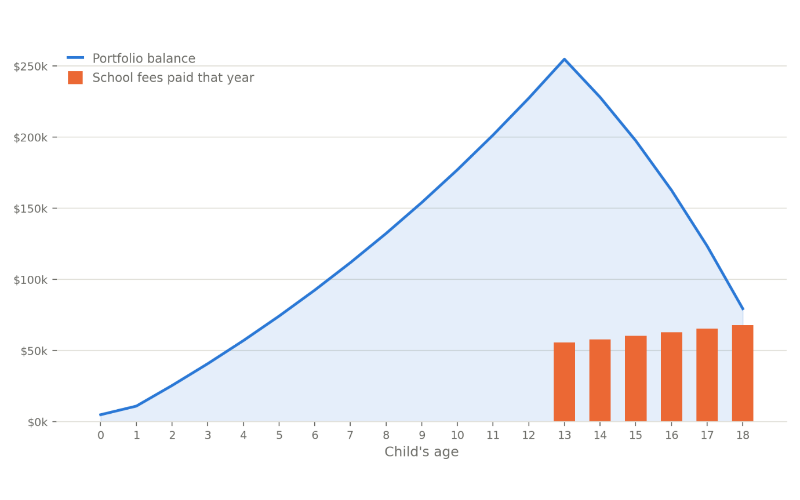
The numbers will vary with the school, the contribution amount, and the returns actually achieved, but the principle remains: the earlier you start, the more of a job compounding does for you, and the smaller the ongoing cashflow impact.
Where should the money sit?
How you hold this investment matters just as much as how much you contribute; the wrong structure can hand a large chunk of your returns straight to the tax office.
1. In the child's own name
This is the option many parents instinctively reach for, but it's usually the least tax-effective. Under the "tax on minors" rules, unearned income from items such as dividends, interest, and rent earned by a child under 18 doesn't get the benefit of an adult tax-free threshold. Instead, a minor's tax-free threshold on this type of income is just $416, income between $417 and $1,307 is taxed at up to 66%, and anything above that is taxed at the top marginal rate (currently 45%, or effectively around 47% including the Medicare levy). There are some carve-outs, for example, minors working full-time, those with a disability, or those receiving a double orphan pension. For most families, these rules make holding a meaningful investment portfolio directly in a child's name a poor idea.
2. In a parent's (or lower-earning spouse's) name
Holding the investment in the name of a parent, or whichever partner has the lower income, means earnings and capital gains are simply taxed at that person's individual marginal rate. This has historically worked well for anyone earning under roughly $45,000 a year, since income and capital gains in that range attract a marginal rate of 16% or less.
More recently, the Government's 2026–27 Federal Budget proposes replacing the 50% CGT discount with cost-base indexation and introducing a new 30% minimum effective tax rate on capital gains, intended to apply to gains made from 1 July 2027.
If it proceeds as announced, this would result in any capital gain from the investment likely taxed at the 30% rate whilst the income produced would be taxed at the rate of 16% or less (depending on what the income ends up as for the financial year).
3. Education bonds
An education bond is a purpose-built, tax-effective investment structure for funding education costs (though the funds can technically be used for anything). You can select different investment options in this structure ranging from index options to actively managed options.
Key features:
Tax is paid inside the bond, at a maximum rate of 30%, you generally don't declare the earnings in your own tax return.
The 10-year rule: if the bond is held for 10 years or more, withdrawals are tax-free, including any realised capital growth from the withdrawal.
The 125% rule: to preserve that 10-year concession, contributions in any year generally can't exceed 125% of the previous year's contribution; if you exceed it, the 10-year clock resets.
The Education Tax Benefit: if withdrawals are used for eligible education expenses, you can receive back some of the tax already paid inside the bond, broadly, an extra $30 rebate for every $70 of earnings withdrawn.
Ownership and access: bonds can generally be opened by anyone 16 or over on behalf of a child, with flexibility around who ultimately controls and benefits from the funds.
For families on higher marginal tax rates in particular, the 30% cap inside the bond can be considerably more attractive than paying tax at 45–47% personally, with the added bonus of the education rebate on top.
The bottom line
There's no single "right" structure; it depends on your income, your marginal tax rate, how much flexibility you want, and how far away school fees are.
What all three approaches have in common is that starting earlier gives compounding more time to work, and materially reduces the amount you need to find from cash flow once school fees actually arrive.
As with any investment or tax structuring decision, the right approach depends on your personal circumstances, and getting it wrong can be costly. We'd always recommend speaking with your adviser before setting up an education investment strategy, so it's tailored to your income, your goals, and your children's schooling plans.
